

What Is Inflation Actually?
I remember filling up my car in 2020 for $28. The same tank cost me $54 in 2022. Nothing changed except the price. That was the moment inflation stopped being a news word and started being a real thing I felt every week.
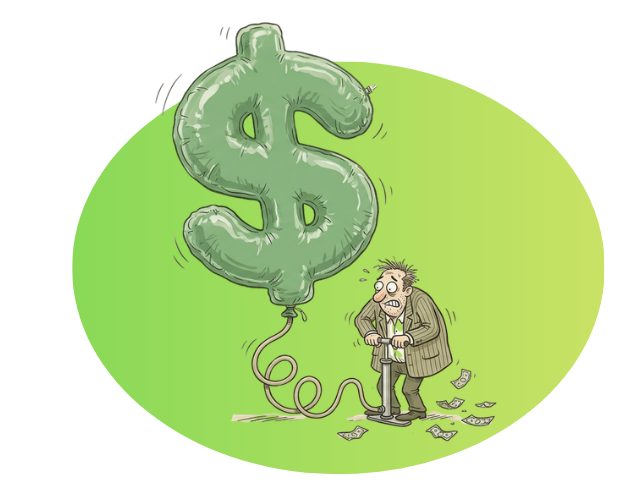
So, inflation is the rate at which prices rise over time.
That’s it. When inflation is 3%, something that cost $100 last year costs $103 today. Your dollar buys less than it did before, it has lost it’s purchasing power.
It’s not a one-time price spike. It’s a continuous process. Prices creep up year after year, and most people don’t notice until the damage is done.
Think about your grocery bill. You’re buying the same items you always have. Same brands, same quantities. But the total at the register keeps climbing. That’s inflation in your daily life.
Here’s the part people miss:
- Inflation doesn’t just affect what you spend
- It affects what your saved money is worth
- A $100 bill sitting in your wallet is losing value right now, even if you never touch it
The dollar itself isn’t shrinking. The number on the bill stays the same. What changes is what that number can buy you.
In 2000, the average price of a movie ticket in the US was $5.39. By 2024 it was over $11. The ticket didn’t change. The dollar did.
So when people say ‘my money doesn’t go as far as it used to,’ they’re not imagining it. They’re describing inflation accurately, just without the label.
The question worth asking is not whether inflation is happening. It is always happening to some degree. The real question is whether your income and savings are keeping up with it.
Spoiler: for most people, they aren’t.
How It Gets Measured
The US government tracks inflation using the Consumer Price Index, or CPI.
Every month, the Bureau of Labor Statistics (BLS) tracks the prices of a fixed list of goods and services. They compare this month’s prices to last month’s, and last year’s. The percentage change is the inflation rate. (Learn about real vs nominal returns)
That list of goods is called the basket. It includes things like:
- Groceries and food at home
- Rent and housing costs
- Gas and transportation
- Medical care
- Clothing
- Education
- Recreation
The basket is designed to reflect what a typical American household spends money on. Each category is weighted by how much of your budget it tends to take up. Housing carries more weight than clothing because most people spend more on rent than on shirts.
When the CPI rises 3%, it means that basket of goods costs 3% more than it did a year ago.
Your inflation rate is not necessarily the CPI number you see in the news. If you rent in a city where rents are rising 10%, your real inflation is higher than the national average. If you drive a lot and gas prices spike, you feel that more than someone who takes the subway.
The CPI is an average. And averages hide a lot.
There is also a version called Core CPI, which strips out food and energy prices because they tend to be volatile. Economists use it to see underlying trends. But food and gas are exactly what most people spend money on every week, so Core CPI can feel disconnected from real life.
The number to watch is the headline CPI. It’s what affects your actual day-to-day costs.
What Causes Inflation
Inflation doesn’t just happen randomly. There are specific forces that push prices up. Understanding them helps you make sense of why prices spiked in 2021 and why your grocery bill looks the way it does today.
There are three main causes.
1. Too much money chasing too few goods
When people have more money to spend, businesses can charge more. Demand goes up, prices follow.
(How the Fed controls inflation)
This happened during COVID. The government sent out stimulus checks. People had cash but couldn’t spend it on experiences like travel or restaurants. So they bought stuff. Electronics, furniture, home gym equipment. Demand for goods exploded while supply couldn’t keep up. Prices rose.
Economists call this demand-pull inflation.
2. Rising costs get passed on to you
When it costs more to make something, companies charge more for it. Higher wages, more expensive raw materials, pricier shipping — all of it eventually shows up on the price tag.
After COVID, shipping containers were stuck in the wrong ports. Fuel prices rose. Labor was scarce. Every extra cost a company absorbed got passed down the chain and landed with the consumer.
Economists call this cost-push inflation.
3. Money supply expansion
When the Federal Reserve prints more money or keeps interest rates very low for a long time, more dollars flow into the economy. More dollars competing for the same amount of goods pushes prices up.
This is the one that gets the most attention in political debates. It’s real, but it’s rarely the only cause. Inflation is almost always a combination of all three happening at once.
The 2021-2022 inflation surge was a perfect example. Stimulus money hit the economy, supply chains were broken, and interest rates had been near zero for years. All three causes fired at the same time. The result was the highest inflation the US had seen in 40 years, peaking at over 9% in June 2022.
Who Controls It and How
The Federal Reserve is responsible for keeping inflation under control in the US.
The Fed is the country’s central bank. It doesn’t set the price of milk or gas. What it controls is the cost of borrowing money. That one lever, used correctly, can slow down an entire economy.
When inflation is high, the Fed raises interest rates — specifically, the federal funds rate. When that rate goes up, borrowing becomes more expensive across the board.
- Your mortgage rate goes up
- Your car loan gets more expensive
- Credit card interest rises
- Business loans cost more
When borrowing is expensive, people spend less. Businesses invest less. Demand drops. And when demand drops, prices stop rising as fast.
Rate increases don’t work overnight. It typically takes 12 to 18 months for a rate hike to fully work its way through the economy. Between 2022 and 2023, the Fed raised rates 11 times, taking the federal funds rate from near zero to over 5%. Inflation did come down, but millions of people felt the side effects — higher mortgage payments, tighter credit, slower hiring.
The Fed has a dual mandate — two goals it is required by law to pursue:
- Stable prices, meaning low and controlled inflation
- Maximum employment, meaning as many people working as possible
Those two goals sometimes pull in opposite directions. Raising rates to fight inflation can cause job losses. It’s a balancing act with no perfect answer.
Why Some Inflation Is Expected
Not all inflation is bad. A small, steady amount is actually what the Fed aims for.
The target is 2% per year.
(See also: How to use the Rule of 72 to measure inflation’s impact)
At that level, prices rise slowly enough that people can plan around it. Businesses can set prices with confidence. Workers can negotiate wages. Lenders can charge fair interest. The economy moves forward in a predictable way.
If prices aren’t rising, people have less reason to spend today. Why buy something now if it will cost the same or less next year? When spending slows across an entire economy, businesses make less money, hire fewer people, and cut wages. That spiral has a name.
It’s called deflation, and it’s worse than moderate inflation.
Japan spent most of the 1990s and 2000s stuck in deflation. Prices fell, consumers waited to spend, businesses contracted, wages stagnated. It took decades to climb out. Economists still study it as a warning.
So the 2% target exists for a reason:
- It gives the economy room to grow
- It encourages spending and investment now rather than later
- It gives the Fed space to cut rates during a downturn without hitting zero immediately
- It provides a buffer against accidental deflation
The danger zone is on both ends. Too low, and you risk deflation. Too high, and purchasing power erodes faster than wages can keep up. The 2% target is the Fed’s attempt to thread that needle every single year.
What It Means for You
Everything in the previous chapters is abstract until it hits your paycheck.
Your salary is a number. Inflation is a rate. The only thing that matters is whether one is keeping up with the other.
Say you earn $60,000 a year and get a 3% raise. That’s $1,800 more. Feels good. But if inflation that year is 4%, your raise didn’t keep up. In real terms, you took a pay cut. You’re earning more dollars but buying less with them.
This is the difference between your nominal salary and your real salary.
- Nominal salary: the number on your paycheck
- Real salary: what that number actually buys you
Most people track the first one. Almost nobody tracks the second.
Ask yourself one question: over the last three years, have my raises outpaced inflation?
If you don’t know, look it up. The BLS publishes CPI data going back decades. Compare it to your salary history. The answer might surprise you.
Your savings face the same problem.
$10,000 sitting in a checking account earning 0.01% interest loses ground every single year. At 3% inflation, that $10,000 has the purchasing power of roughly $7,400 in ten years. You never spent a cent, but you lost the equivalent of $2,600.
That’s the cost of doing nothing.
The people who come out ahead are not necessarily the ones earning the most. They are the ones who understand that every dollar needs to be working hard enough to at least match inflation, for example: long term investing in a cheap ETF
The next articles in this series are about exactly how to do that.