

What Diversification Actually Means
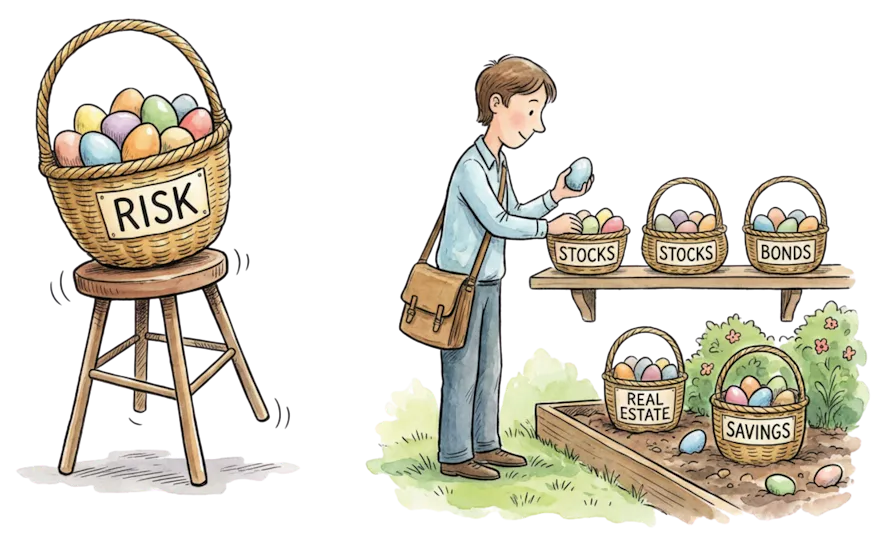
Diversification means spreading your money across multiple investments so that one bad outcome doesn’t wreck everything.
If you put all your money into one company’s stock and that company has a terrible year, you lose big. If your money is spread across 500 companies and one of them collapses, you barely feel it. The other 499 carry on.
I have a friend who put most of his savings into his employer’s stock because he believed in the company. The company had a terrible year, laid off half the team including him, and his portfolio dropped 60% at the same time he lost his income. Both things happened together because they were the same bet.
That’s the core idea. Don’t concentrate risk. Spread it.
Owning a lot of different things is not the same as being diversified. Ten technology stocks is not diversification — it’s concentration in one sector. Real diversification means spreading across different companies, different industries, and ideally different asset types.
The goal is not to eliminate risk entirely. Some risk is unavoidable and necessary for growth. The goal is to avoid the kind of catastrophic loss that comes from putting everything on one bet. Starting late — risk tolerance shifts.
How an Index Fund Does It Automatically
An S&P 500 index fund gives you instant diversification across 500 companies in one purchase.
Those 500 companies span technology, healthcare, finance, consumer goods, energy, real estate, and more. When one sector struggles, others often hold steady or rise. The portfolio breathes as a whole rather than depending on any single company’s performance.
When a company inside the index has a disaster — a scandal, a bankruptcy, a product failure — its weighting in the fund shrinks automatically. You don’t have to do anything. You don’t have to sell. The index rebalances itself.
This is why index funds are often described as the easiest form of diversification available to a regular investor. You don’t need to research individual companies. You don’t need to monitor your holdings. You buy once, contribute regularly, and own a proportional slice of the American economy.
What Over-Diversification Looks Like
You can have too much of a good thing.
Some investors buy ten different funds thinking more funds means more diversification. Often it just means overlap. An S&P 500 fund and a total US market fund both hold most of the same companies. Owning both doesn’t reduce your risk — it just adds complexity.
Signs you are over-diversified:
- You own multiple funds that hold the same stocks
- You can’t explain what each fund does differently
- Your returns look identical across all of them
A simple two or three fund portfolio covers almost everything most investors need:
- A US total market or S&P 500 fund
- An international fund for exposure outside the US
- A bond fund if you want to reduce volatility as you approach retirement
That’s it. Three funds, fully diversified, low cost, easy to manage. With compounding doing its thing, most professional investors don’t do meaningfully better than this over the long run.
Complexity is not sophistication. Simple and consistent wins.
And live below you means.