

And Why It Matters More Than Your Salary
Your Salary Is a Lie – What is Purchasing POwer
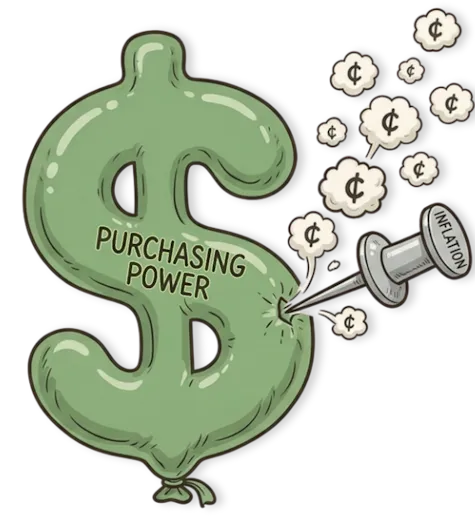
Not literally. But kind of.
The number on your paycheck tells you how many dollars you earn. It does not tell you what those dollars can actually buy. That distinction matters more than most people realize.
Purchasing power is what your money can do in the real world.
$50,000 a year sounds the same whether it’s 2005 or 2025. But in 2005, that salary went a lot further. Rent was cheaper. Groceries cost less. A tank of gas didn’t hurt as much. The number stayed the same. The world around it changed.
That gap between what you earn and what you can buy is purchasing power at work.
Think about it this way:
- You get paid $1,000
- A grocery run costs $200
- That $1,000 buys you five grocery runs
Next year, same $1,000. But now that grocery run costs $220 because prices went up.
- Same paycheck
- Same groceries
- Now you can only afford four and a half runs
You didn’t get poorer on paper. But you got poorer in real life.
This is why chasing a bigger salary number without thinking about what it actually buys you is only half the picture. A $5,000 raise sounds great. But if the cost of your rent, food, gas, and bills went up by $6,000 that year, you are behind.
I got a 4% raise one year and genuinely felt good about it. Then I sat down and realised my rent had gone up 7%, groceries were up 5%, and my health insurance premium had jumped. I ended the year behind. The raise was real. The progress wasn’t.
The number on your paycheck is just a number. What it buys you is the point.
Why Your Money Buys Less Every Year
Prices don’t stay still. They move up. Almost always up.
That’s inflation doing its thing in the background, every single day, whether you’re paying attention or not.
Here’s a real example.
In 2000, the average American spent about $5,000 a year on groceries.(source) Today that same basket of food costs closer to $9,000. Your fork, your fridge, your cereal — all of it costs more. Not because the food got better. Because the dollar got weaker.
Use the Rule of 72 to see how fast prices double
If your income didn’t grow at the same rate, you lost ground. Simple as that.
The tricky part is how slow it happens.
Prices don’t double overnight. They creep up 3%, 4%, sometimes 5% a year. That’s easy to ignore month to month. But zoom out ten years and the damage is real.
A salary of $40,000 that hasn’t moved in a decade is not the same salary it was. In purchasing power terms it’s worth closer to $28,000 today. You didn’t take a pay cut on paper. But your life got more expensive while your paycheck stayed flat.
Most people feel this but can’t explain it. They make roughly what they always made, work just as hard, but somehow money feels tighter than it used to.
That’s not a feeling. That’s math.
The cost of living doesn’t send you a bill for the difference. It just quietly makes everything a little harder to afford, a little more stressful, a little more out of reach.
How to Know If You’re Actually Getting Ahead
Most people celebrate a raise without checking if it actually means anything.
A 3% raise sounds good. But if inflation that year was 4%, you effectively took a 1% pay cut. More dollars, less power. The math doesn’t care how good the news felt in the moment.
So how do you know if you’re actually getting ahead?
One question. That’s all it takes.
Did my income grow faster than inflation this year?
If yes, you gained ground. If no, you lost it. Everything else is noise.
Here’s how to check it yourself:
- Find the current inflation rate — the Bureau of Labor Statistics publishes it free at bls.gov
- Look at your income change over the past year as a percentage
- Subtract inflation from your income growth
- A positive number means you gained purchasing power
- A negative number means you lost it, even if your paycheck grew
Say you got a 4% raise and inflation was 3%. You’re up 1% in real terms. Not life changing, but you moved forward.
Say you got a 2% raise and inflation was 4%. You’re down 2% in real terms. You are working the same hours for a smaller slice of the pie.
Take this into every salary conversation you have.
Don’t just ask for a raise. Ask for a raise that beats inflation. Know the current rate before you walk into that room. Most managers won’t bring it up. You should.
Your salary number is what your employer sees. Your purchasing power is what your life actually feels.
Track the right one.
What You Can Do About It
Knowing your purchasing power is shrinking is useful. Doing something about it is the point.
Here’s what actually moves the needle.
Stop letting cash sit still
Money in a basic checking account earning near zero is losing ground every year. At minimum, your savings should be in a high yield savings account paying somewhere around 4% to 5%. That won’t make you rich but it slows the bleed while you figure out the rest.
Invest the difference
The only reliable way to grow purchasing power long term is to put money into things that grow faster than inflation. A low cost index fund tracking the S&P 500 has averaged around 10% a year historically. That beats a 3% inflation rate by a wide margin over time.
You don’t need a lot to start. Some brokerages let you begin with $1.
Negotiate like you know the numbers
Walk into every salary review knowing the current inflation rate. If your employer offers 2% and inflation is 4%, that is a pay cut dressed up as a raise. Push for more. Frame it around purchasing power, not just effort or tenure.
Grow your income outside your job
A side hustle, a freelance skill, selling something online — any extra income stream gives you more purchasing power to work with and less dependence on a single employer to keep up with rising costs.
No single move fixes everything. But each one compounds.
The goal is simple: make sure your money grows faster than the world around it gets more expensive.
That’s it. That’s the whole game.