

What Is Lifestyle Creep?
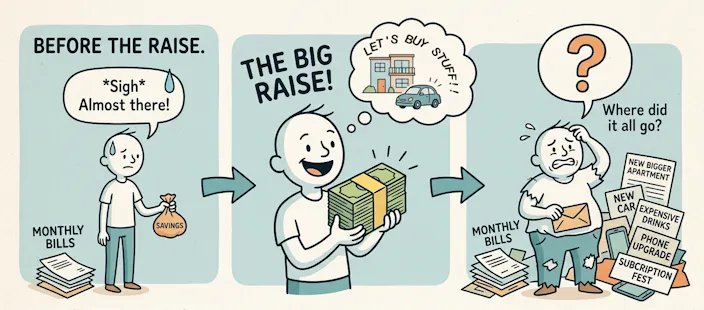
You get a raise. You feel good. A few months later, the money is gone and you’re not sure where it went.
That’s lifestyle creep.
It happens when your spending rises in step with your income. Every time you earn more, you spend more. The gap between income and spending stays the same or shrinks. Saving and investing never really happen because there’s never quite enough left over. That’s why living below your means is important.
The frustrating part is how invisible it feels. You’re not blowing money on anything dramatic. You just upgraded a few things. Got a nicer apartment. A newer car. Started ordering delivery more often. Added a few subscriptions.
Each one felt reasonable at the time. Together they absorbed every extra dollar you earned.
See also: What Is Purchasing Power.
How It Happens Without You Noticing
Lifestyle creep rarely arrives all at once.
Every time I got a raise in my 20s the money just vanished. Better apartment, nicer restaurants, a gym membership I used twice. I was earning 40% more than when I started my first job and saving exactly the same amount. Nothing. It took me an embarrassingly long time to notice.
It happens one upgrade at a time. You get a promotion and move to a nicer neighborhood. Makes sense — you worked hard. Then you need a car that fits the neighborhood. Then the restaurants nearby cost a bit more. Then you want furniture that matches the apartment.
None of it feels reckless. All of it compounds.
Social pressure plays a role too. When your income rises, your social circle often shifts. People around you spend more. Keeping up feels normal, not extravagant. (Research on lifestyle inflation)
The other trap is the mental shift from luxury to necessity. The first time you ordered food delivery it felt like a treat. Now it’s just Tuesday. The first streaming service was optional. Now you have four and canceling one feels like a sacrifice.
Luxuries become defaults. Defaults become non-negotiable. Your baseline cost of living quietly inflates.
How to Stop It
The fix has to happen before the money hits your checking account.
Every time your income increases, automate a portion of the raise directly into savings or investments before you adjust your lifestyle. If you never see it, you never spend it. Compound interest rewards this habit.
A useful rule: save at least 50% of every raise.
Say you get a $500 a month raise. Put $250 straight into your investment account automatically. Spend the other $250 however you want. Your lifestyle still improves. But half the raise is now building your future instead of funding a slightly more expensive present.
See also: What Is an Index ETF.
Before any lifestyle upgrade, ask one question: is this a deliberate choice or am I just drifting upward?
Some upgrades are worth it. A better mattress, a safer car, a home in a good school district — these can improve your life in real ways. The goal is not to refuse every upgrade. It’s to choose them instead of defaulting to them. You can also get a side hustle to supplement income.
Intentional spending and lifestyle creep look similar from the outside. The difference is who is in control.